

',Live', on the Coast
4 620 Ft
',Live', on the Coast
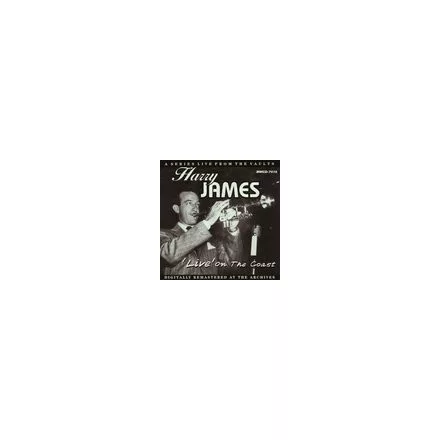
JazzRecorded: 1943-1944Vocalist: a- Buddy Moreno b- Helen WardHarry James and his orchestra were recorded at the Hollywood Palladium from December 27, 1943 to February 6, 1944. 4 tracks of the 22 feature vocalist Helen Ward. As a bonus, three V Disc performances from the period conclude the program: the instrumental Sierra, skillfully arraigned by Jimmy Mundy, Buddy Moreno"s version of Too Marvelous For Words, both recorded at a special V Disc session at Columbia Studio"s in Hollywood on November 17, 1943.While in New York, appearing at the Astor Roof, Johnny Thompson penned the excellent arrangement of On The Alamo. Special Services in charge of the V Disc program extracted this up tempo rendition from a June 15 broadcast. Harry James" string of hits would continue when he resumed recording in late 1944. This compact disc shows that he and his big band were making great music even when the recording studios were temporarily silent. Harry JamesActive Decades: "30s, "40s, "50s, "60s and "70sBorn: Mar 15, 1916 in Albany, GADied: Jul 05, 1983 in Las Vegas, NVGenre: JazzStyles: Big Band, Swing, Traditional Pop, Sweet BandsHarry James was one of the most outstanding instrumentalists of the swing era, employing a bravura playing style that made his trumpet work instantly identifiable. He was also one of the most popular bandleaders of the first half of the 1940s, and he continued to lead his band until just before his death, 40 years later. James was the child of circus performers. His father, Everette Robert James, was the bandleader and trumpet player in the orchestra for the Mighty Haag Circus, and his mother, Maybelle Stewart Clark James, was an aerialist. Growing up in the circus, James became a performer himself as early as the age of four, when he began working as a contortionist. He soon turned to music, however, first playing the snare drum in the band from about the age of six and taking trumpet lessons from his father. At 12, he took over leadership of the second band in the Christy Brothers Circus, for which his family was then working. He attended grade school in Beaumont, TX, where the circus spent the winter, and when he was 14 he won a state music contest as a trumpeter. That inspired him to turn professional and begin playing in local bands. James" first job with a national band came in 1935 when he was hired by Ben Pollack. In May 1935, he married singer Louise Tobin, with whom he had two children and from whom he was divorced in June 1943. He made his first recordings as a member of the Pollack band in September 1936. Not long after, he was tapped by Benny Goodman, then leading one of the country"s most popular bands, and he began working for Goodman by the end of 1936. He rapidly gained notice in the Goodman band, and by December 1937 he had begun to make recordings under his own name for Brunswick Records (later absorbed by Columbia Records). In early 1939, he left Goodman and launched his own orchestra, premiering it in Philadelphia in February. That spring, he heard the then-unknown Frank Sinatra on a radio broadcast and hired him. The band struggled, however, and when the more successful bandleader Tommy Dorsey made Sinatra an offer at the end of 1939, James did not stand in his way. Around the same time, he was dropped by Columbia and switched to the tiny Varsity Records label. After two years of difficulties in maintaining his band, James changed musical direction in early 1941. He added strings and turned to a sweeter, more melodic style, meanwhile re-signing to Columbia Records. The results were not long in coming. In April 1941, he first reached the Top Ten with the self-written instrumental "Music Makers." (His band was sometimes billed as Harry James and His Music Makers.) A second Top Ten hit, "Lament to Love," featuring Dick Haymes on vocals, followed in August, and late in the year James reached the Top Five with an instrumental treatment of the 1913 song "You Made Me Love You (I Didn"t Want to Do It)." This was the record that established him as a star. But with its sweet style and what was frequently described as James" "schmaltzy" trumpet playing, it was also, according to jazz critic Dan Morgenstern (as quoted in the 1999 biography -Trumpet Blues: The Life of Harry James by Peter J. Levinson), "the record that the jazz critics never forgave Harry for recording." James was second only to Glenn Miller as the most successful recording artist of 1942. During the year, seven of his recordings peaked in the Top Ten: the Top Five "I Don"t Want to Walk Without You," with vocals by Helen Forrest
4 620 Ft
Adatok
Vonalkód
10281
Adathordozó
CD
Első megjelenés
2009
Gyártási év
2009
Énekes
Cikkszám
10281